
Hey, awesome people.
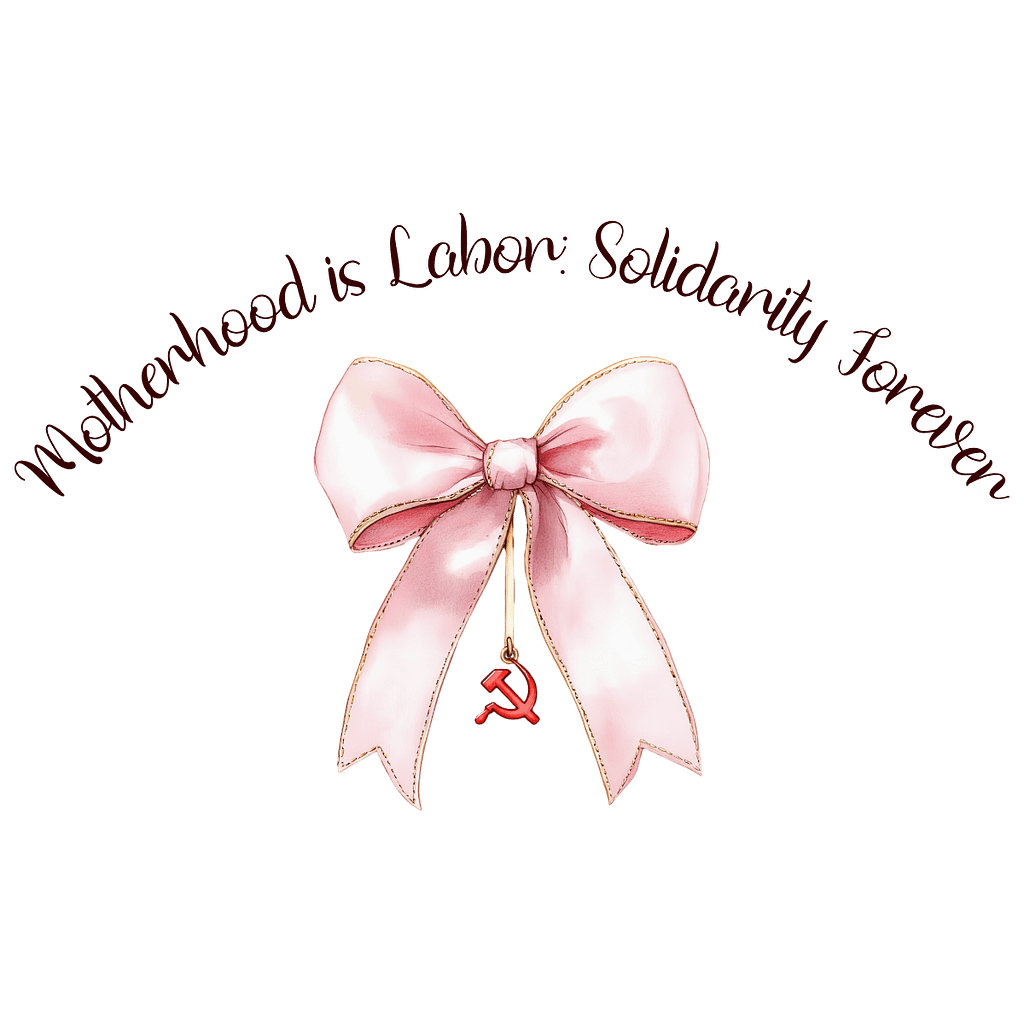
At first glance, a delicate pink bow feels like it belongs in a quiet nursery or a curated “coquette” mood board. It’s soft, it’s feminine, and it’s unapologetically pretty. But look closer at this week’s design, and you’ll see the hammer and sickle—a symbol that demands we stop romanticizing the “soft life” and start looking at the hard labor that sustains it.
For too long, we’ve been told that motherhood is a private journey, a “labor of love” that exists outside the realm of economics and politics. We are told to “lean in” individually or find “work-life balance” in a system that provides neither. But when we say Motherhood is Labor, we are stripping away the sentimental filters. We are acknowledging that raising the next generation is the literal engine of society—and it’s an engine currently running on the fumes of unpaid, undervalued, and isolated work.
This isn’t just about “mom guilt” or finding a better daycare. It’s about Solidarity Forever. It’s a call to move beyond the isolation of the modern nuclear family and recognize that our struggle for a livable life isn’t a personal failing; it’s a political necessity.
In a world that wants us to struggle in silence, wearing the bow becomes an act of defiance. It’s a signal that we aren’t just “getting by”—we’re organizing.
The Myth of the “Self-Sufficient” Nuclear Family
We are often led to believe that the “ideal” family is a self-contained unit—a tiny, private island where two parents (and, increasingly, just one) are expected to provide everything: education, emotional regulation, healthcare, and financial stability. We’ve been conditioned to view needing help as a failure of our own planning or a lack of “hustle.”
But this isolation isn’t an accident; it’s a design flaw of a system that profits from our solitude. By privatizing the costs of raising children, the burden of “social reproduction”—the work of feeding, clothing, and raising the next generation of workers—is shifted entirely onto the backs of individuals. This “rugged individualism” is a trap. It keeps us so busy just trying to keep our heads above water that we don’t have the time to look up and realize our neighbors are drowning, too.
Look at the current landscape in the US: we are living through a care crisis. Childcare costs now rival mortgage payments, paid maternity leave remains a luxury rather than a right, and “the village” we were promised has been replaced by expensive subscription services. When the system fails—when a kid gets sick, when a daycare closes, or when inflation eats the grocery budget—the “self-sufficient” family is expected to simply absorb the blow.
The truth is, no family is an island, and no mother should be expected to be a one-woman safety net. When we cling to the myth of the nuclear family as a closed circuit, we ignore the fact that the very foundation of our society is built on labor that is currently being stolen from us in the name of “love.” It’s time to stop trying to be “enough” on our own and start demanding a world that actually supports the life we are working so hard to create.
What “Solidarity Forever” Means for Parents
When we hear the phrase “Solidarity Forever,” we usually think of picket lines, factory floors, and union halls. But solidarity isn’t just for the workplace; it’s for the home, the playground, and the grocery store. It is the bridge between our private struggles and our collective power.
To practice solidarity in motherhood is to move beyond surface-level support. We’ve all seen the “mom groups” that offer tips on the best sleep sacks or where to find a sale on organic snacks. While that community is valuable, it isn’t solidarity. Solidarity is a political commitment. It’s the shift from saying “I hope you find a way to afford childcare” to “I am fighting alongside you for universal childcare because your child’s well-being is my responsibility, too.”
This means embracing an intersectional view of care. Solidarity recognizes that the struggles of a stay-at-home mom are inextricably linked to the struggles of the nanny she might hire, the teacher at the local school, and the retail worker trying to balance a shift with a sick toddler at home. We cannot win better conditions for “mothers” if we aren’t also fighting for living wages, reproductive freedom, and healthcare for all workers.
At its core, this is about reclaiming the concept of social reproduction. In socialist theory, this is the idea that the labor performed within the home—cooking, cleaning, emotional support, and raising children—is what makes all other work possible. By demanding solidarity, we are insisting that this work be moved from the shadows of the “private sphere” into the light of the public conscience.
We aren’t asking for a helping hand; we are demanding a seat at the table. When we stand in solidarity, we acknowledge that my liberation as a mother is bound up in yours. We stop competing for the few resources the system throws us and start organizing to change the system itself.
From Decoration to Demonstration: Real-World Solidarity
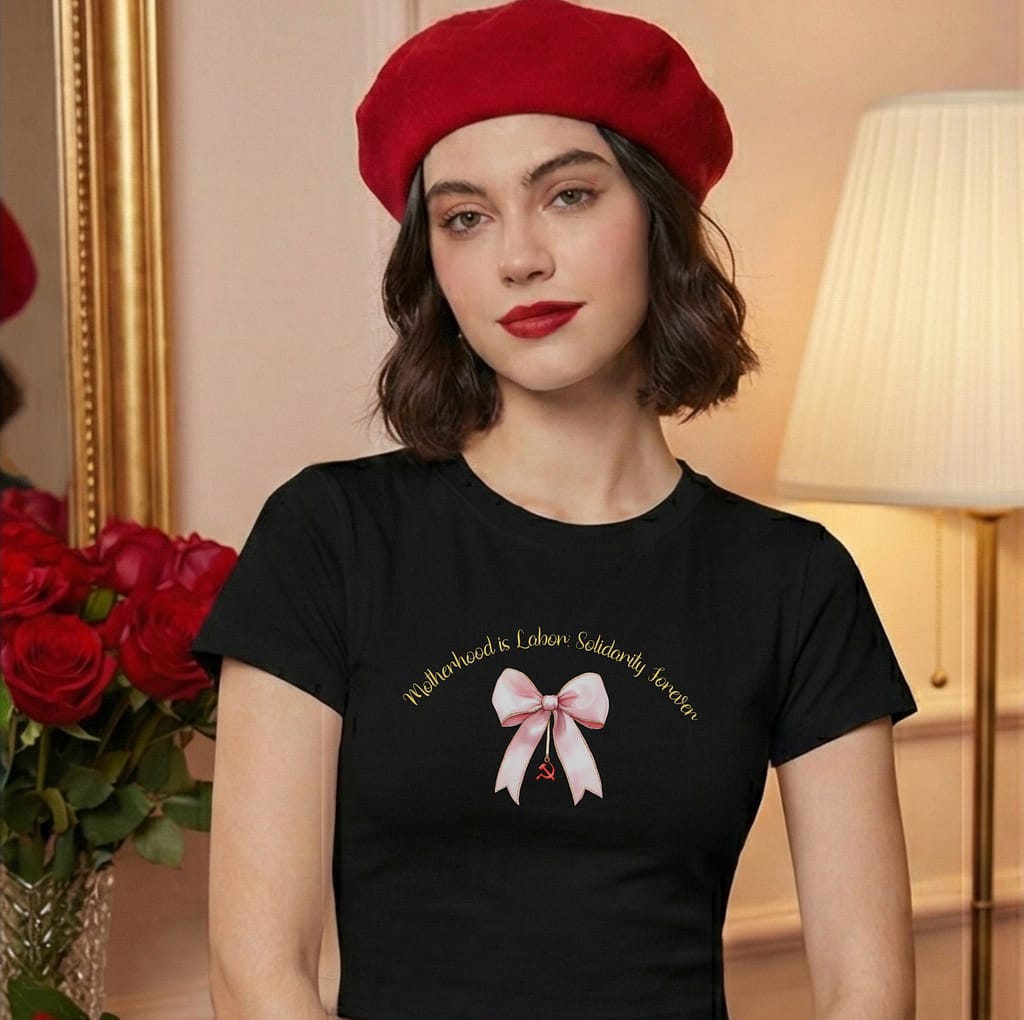
It is easy to look at a pink bow and see a trend, but when we pair it with the call for solidarity, it becomes a manifesto. We are living in a moment where the cracks in the system are no longer possible to ignore. From the skyrocketing costs of basic necessities to the legislative attacks on reproductive autonomy, the “private” life of the family is being squeezed from every angle.
But where there is pressure, there is also the opportunity for organization. We are seeing a resurgence of parent-led activism that refuses to accept the status quo. Whether it’s the fight to reinstate the Child Tax Credit, the push for Universal Pre-K, or the growing movement for Paid Family Leave, these aren’t just “women’s issues”—they are labor demands.
“Solidarity Forever” manifests in our communities every day through:
- Mutual Aid: Families organizing diaper banks, meal trains, and “buy nothing” groups to bypass capitalist gatekeepers and ensure everyone has what they need.
- Childcare Cooperatives: Parents pooling resources and time to create their own “villages” when the state refuses to provide them.
- Political Advocacy: Showing up to school board meetings and state legislatures to demand that our tax dollars fund care and education rather than corporate subsidies.
This design is intended to be a conversation starter in these spaces. When you wear it to the park, the grocery store, or a local rally, you are sending a signal. You are telling every other exhausted parent who catches your eye, “I see your labor. I value your work. And I am willing to fight for a world where we don’t have to do this alone.”
The pink bow is our invitation to the movement. It’s a reminder that we don’t have to sacrifice our softness to be strong, and we don’t have to sacrifice our politics to be mothers. We are building a future where care is the heartbeat of the economy—and that future starts with the radical act of standing together.
Reclaiming the Pink Bow
At the end of the day, motherhood is not a solo performance. We’ve been conditioned to believe that if we’re tired, it’s because we aren’t organized enough; if we’re broke, it’s because we didn’t “hustle” enough; and if we’re lonely, it’s just the nature of the job. But these are lies designed to keep us from looking at the person next to us and realizing we are all carrying the same weight.
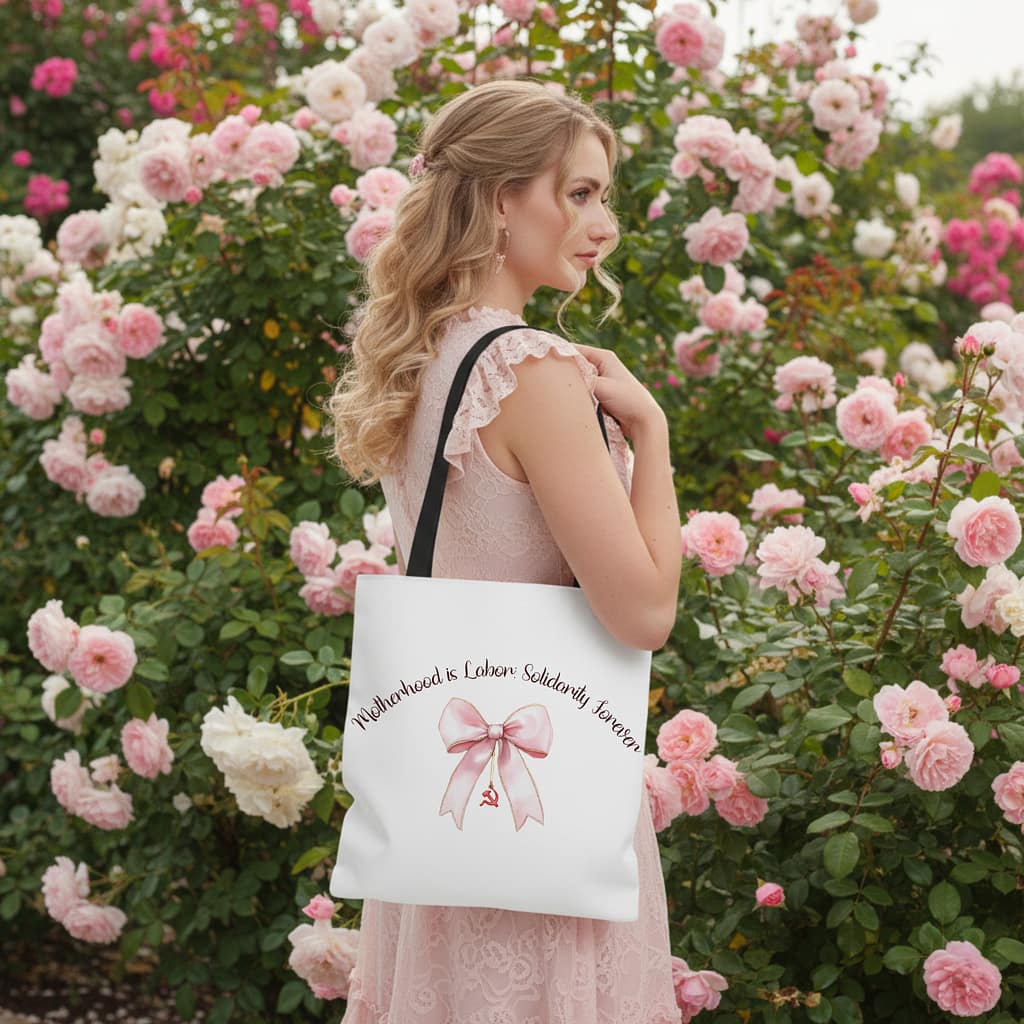
By reframing our daily lives through the lens of labor and solidarity, we take back our power. We stop asking for permission to be supported and start demanding it as a right. The pink bow in this design is a nod to our femininity, our softness, and the beauty of care—but the hammer and sickle underneath is the reminder that this softness is backed by the strongest force on earth: the worker.
We aren’t just “getting by” anymore. We are building a world where the “village” isn’t a nostalgic myth but a political reality. We are creating a future where care is the center of our economy, not an afterthought in a spreadsheet.
So, let’s wear the bow, tell our stories, and refuse to be invisible. Because when mothers stand together, “Solidarity Forever” isn’t just a song—it’s the blueprint for a new world.
What does parenting solidarity look like in your life? Are you part of a local mutual aid group, or are you fighting for better leave policies at work? Let’s talk about it in the comments below.
[Shop the “Motherhood is Labor” Collection here.]
Stay sparkly (and radical).